Non UK Casinos — What You Actually Give Up
Offshore sites sell themselves on freedom: no limits, no checks, keep your winnings. This is what that freedom costs, and why the lists ranking the "best non UK casinos" almost never mention it.
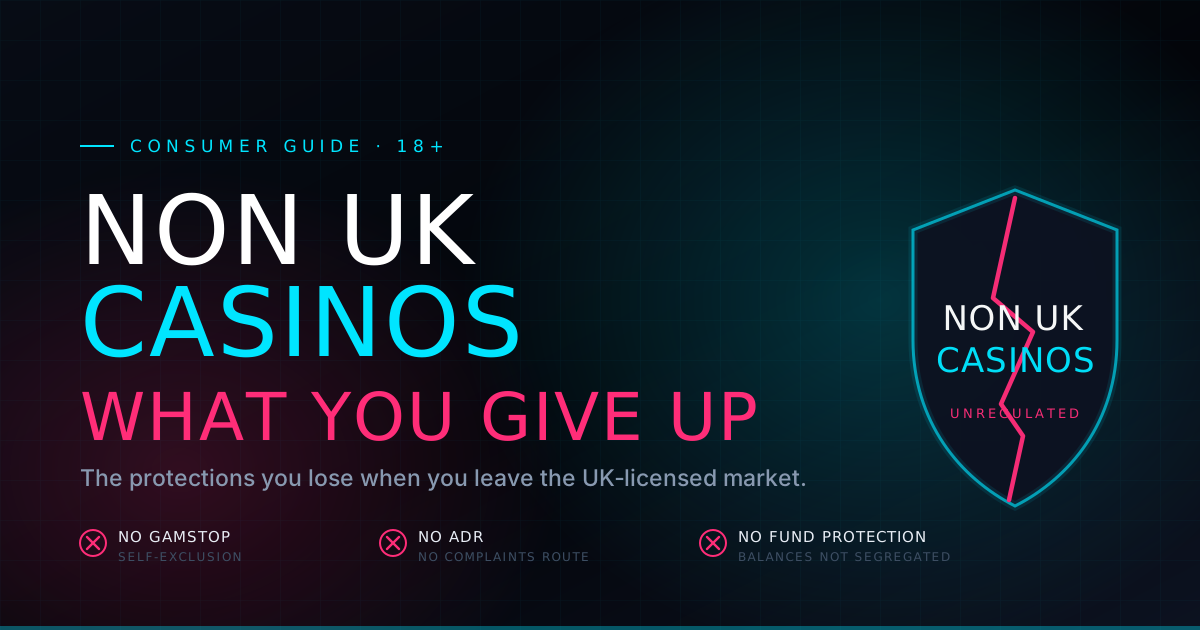
⚠ Read this first
This article does not recommend any casino and contains no affiliate links. If you are looking for a list of offshore operators to sign up with, you are on the wrong page. If you want to understand what you lose by leaving the UK-licensed market, keep reading. If you are self-excluded via GAMSTOP, the honest answer is that no offshore site is safe for you — skip to Where to get help.
What "non UK casinos" actually means
A non UK casino is an online gambling site that accepts British players without holding a licence from the UK Gambling Commission. It is not a category defined by geography or by quality. It is defined by an absence: the absence of the regulator whose entire job is to make operators behave when it costs them money to do so.
These sites usually hold a licence from somewhere else. Curaçao is the most common, followed by Anjouan, Costa Rica, and occasionally Malta or the Isle of Man. Operators display these licences prominently because a badge in a footer looks like oversight. In practice the level of supervision behind those badges varies from modest to functionally none, and the differences are invisible to a player comparing two homepages side by side.
The marketing language is consistent across the sector, which should itself tell you something. Play freely. No restrictions. Keep what you win. No annoying checks. Every one of those phrases describes the removal of a consumer protection, reframed as a benefit to you. That framing is the product. Understanding what sits underneath it is the point of this article.
Why UK players end up searching for them
Almost nobody wakes up wanting to gamble at a less regulated casino. People arrive at these sites through one of a small number of doors, and it is worth being honest about which one you came through, because it changes how much risk you are carrying.
- You hit an affordability check. A UK operator asked for payslips or bank statements before letting you deposit more, and you did not want to provide them.
- You set a deposit limit and now want past it. UK sites enforce a cooling-off period before a limit can be raised. Offshore sites have no limit to raise.
- You self-excluded and want to play again. You registered with GAMSTOP, the block is working, and you are looking for a way around it.
- You were closed by a UK operator for markers of harm, and want somewhere that will not ask.
- You want a specific game, bonus, or crypto payment not offered in the UK-licensed market.
Only the last of those is a preference. The other four are protections doing exactly what they were built to do. If your reason for looking sits in the first four, the friction you are trying to escape is not an inconvenience — it is the system working. Routing around it does not remove the underlying problem, it removes the thing that was slowing it down.
What a UKGC licence actually gives you
It is difficult to value what you are giving up until you see it itemised. British gambling regulation is not perfect and it is often irritating to deal with. It also does a specific set of concrete things that offshore licensing does not.
| Protection | UK licensed | Typical non UK casino |
|---|---|---|
| Player funds segregated | Required and disclosed | Not required; often commingled with operating capital |
| Independent complaints route (ADR) | Mandatory, free to the player | None; the operator decides its own disputes |
| GAMSTOP self-exclusion | Mandatory integration | Not connected |
| Deposit limits and reality checks | Required, with cooling-off on increases | Optional or absent |
| Affordability and source-of-funds checks | Required | Usually only at withdrawal, if at all |
| Advertising standards | ASA and Commission rules apply | No enforceable standard |
| Game fairness testing | Independent lab certification required | Varies; often unverifiable |
| Regulator with power over your money | Yes | No jurisdiction over UK complaints |
Look at the last row for a moment, because everything else follows from it. The Gambling Commission can fine a licensed operator millions of pounds, force it to repay customers, and remove its ability to trade in a lucrative market. That threat is the reason a UK operator eventually pays a disputed withdrawal. Remove the threat and you are left relying on a company's goodwill in a dispute where it holds your money and you have no leverage.
Segregated funds: the risk nobody advertises
UK licensees must hold customer balances in a way that is disclosed, and must tell you what level of protection applies if the company fails. That disclosure is dull enough that almost nobody reads it. It becomes extremely interesting when an operator goes under.
Offshore licensing generally imposes no such requirement. Your balance may sit in the same account the company uses to pay staff, buy traffic and cover marketing. While the business is healthy this makes no practical difference. If the business stops being healthy, customer balances are simply part of the pot, and players are unsecured creditors of a company incorporated in a jurisdiction where pursuing a claim costs more than most balances are worth.
This is not hypothetical. The offshore sector has a long record of sites going dark with balances still on them: a payments page that stops working, support tickets that stop being answered, then a domain that no longer resolves. The pattern repeats often enough that it has a name in the industry, and it is one of the reasons that "keep your winnings" is such a strange promise to lead with.
The withdrawal problem
If there is a single practical failure that defines the sector, it is this one. Deposits are instant and frictionless. Withdrawals are where verification suddenly appears.
The sequence is consistent enough to be predictable. You deposit without meaningful checks. You play. You win. You request a withdrawal. Only then does the account enter verification: photo ID, proof of address, a selfie holding your document, sometimes a bank statement or a source-of-funds explanation. Each round of documents is reviewed slowly. Documents are rejected for resolution, glare, or a mismatched address, and the clock restarts. Meanwhile your balance sits in the account, and the site remains fully playable.
That last detail is the important one. A stalled withdrawal with a live balance is an invitation to keep playing, and a meaningful share of stalled withdrawals are eventually resolved by the player losing the money back. That outcome costs the operator nothing and requires no bad faith at any single step — just slowness, applied at the right moment.
Where the balance survives verification, bonus terms are the second line. Maximum win caps on bonus funds. Maximum bet rules that void a win if a single spin exceeded a threshold you may have crossed accidentally. Rules about "irregular play" or "bonus abuse" defined vaguely enough to apply to almost anything. In a UK-licensed dispute, an ADR body assesses whether such a term was fair and clearly communicated. Offshore, the operator interprets its own terms, and its interpretation is final.
KYC, but only when it suits
There is a revealing asymmetry in how offshore sites handle identity. Know Your Customer checks exist to prevent money laundering and underage gambling, and a regulated operator runs them at onboarding, before money moves. Running them only at withdrawal inverts the purpose entirely: it stops being a control on who is allowed to gamble and becomes a control on who is allowed to be paid.
The consequences reach beyond your balance. It means minors and self-excluded players can deposit and play without ever being screened. It means someone in the middle of a gambling crisis can lose a great deal of money at a site that will only ask who they are if they happen to win. A protection applied exclusively at the point of payout is not a protection at all.
GAMSTOP, and why "non UK" is often a euphemism
GAMSTOP is the UK's national self-exclusion scheme. You register once, choose a period, and every UK-licensed operator is required to block you for its duration. It is free, it is independent, and for a lot of people it is the single most effective thing they have ever done about their gambling.
Offshore casinos are not connected to it. That is a factual consequence of not holding a UK licence — and it is also, unmistakably, a selling point in how a large part of this sector markets itself. The search demand for these sites is heavily driven by people looking for exactly that gap.
If that describes you, it is worth sitting with what it means. You registered with GAMSTOP at a moment when you had clear sight of the problem. The version of you that made that decision had more information about the pattern of your gambling than the version currently looking for a way past it. Self-exclusion is not a punishment someone imposed on you; it is an instruction you left for yourself, deliberately, for this exact moment.
The offshore market's entire pitch to that audience is that the instruction can be ignored. It is the most profitable segment in the sector precisely because those players are the least able to stop.
How to read a "best non UK casinos" list
Search either best non UK casinos or trusted non UK casinos and you will find dozens of ranked lists, all confident, all differently ordered, most carrying trust language in the headline. Understanding how those pages are built makes them much easier to read.
Nearly all of them are affiliate sites. When you sign up through a link, the site earns either a fixed fee or a share of your losses for as long as you keep an account — revenue share deals commonly run between 25% and 45% of net losses, for life. This produces a specific and under-appreciated incentive: on a revenue share deal, the affiliate is paid more when you lose more. A player who deposits once and withdraws a win is worth very little. A player who never stops is worth a great deal.
The practical tells are easy to spot once you know them:
- Ranking order tracks commission, not quality. The same operators appear at the top across sites that share an affiliate network.
- "Trusted" is a decoration. It is a keyword targeting the phrase people search, not a claim backed by any assessment. Ask what was actually tested — nothing, usually.
- No withdrawal testing. Genuine assessment requires depositing, winning, and withdrawing. Almost no list does this, because it is expensive and produces unflattering results.
- Complaints go unmentioned. An operator with hundreds of non-payment reports will still be listed if it pays well.
- Risks appear only as a legal disclaimer at the bottom, never in the body where they would affect the decision.
You can test any of this yourself in a few minutes. Take the operator names from any list you are reading and search them on independent review platforms — the public complaint record on non uk casinos is a useful counterweight to a page that earns money when you sign up. Read the one and two star reviews specifically, and read the operator's replies. Look for the pattern: how many concern withdrawals, verification loops, or voided balances rather than slow support or a disliked bonus. Bear in mind that review platforms carry their own noise in both directions, so treat volume and consistency of a complaint type as the signal, not any single review.
Bonuses that are larger because they are worth less
Offshore bonuses are enormous compared with the UK market: 300% and 500% matches, four-figure package deals, hundreds of free spins. The size is a direct consequence of deregulation, and it usually reflects the terms rather than generosity.
Wagering requirements of 50x or 60x on bonus and deposit combined are routine, against 20x to 35x on bonus only as a common UK structure. On a 50x deposit-and-bonus requirement, a £100 deposit with a £300 match means turning over £20,000 before a withdrawal is permitted. At a 96% RTP, expected losses over that turnover comfortably exceed the deposit. The bonus is not a gift; it is a commitment to a volume of play with a mathematically negative expectation.
Then come the modifiers: maximum bet caps while a bonus is active, with breaches voiding everything. Game weightings where table games count 10% or 0%. Maximum conversion caps limiting what a bonus can ever become regardless of what you win. Expiry windows short enough to force high-tempo play. Each is individually legal and disclosed somewhere. Collectively they mean a headline number that has very little relationship to what the offer is worth.
Payments, crypto, and the loss of chargeback
Payment method matters more offshore than it does at home, because it determines whether you have any recourse at all once money has left your account.
Card payments carry chargeback rights through the card scheme. Those rights are limited for gambling transactions and banks are not obliged to side with you, but the mechanism exists and is occasionally effective. Many offshore sites therefore steer customers towards methods where it does not exist.
Cryptocurrency is the clearest example. A crypto deposit is final. There is no issuer, no scheme rules, no chargeback and no reversal. If the operator does not pay, the transaction cannot be undone by anyone. Crypto is marketed on privacy and speed, and those are real; the removal of every consumer remedy attached to regulated payment rails is the part that goes unmentioned. Vouchers and certain e-wallets sit in a similar position.
There is a data dimension as well. Verification means sending photo ID, proof of address and sometimes bank statements to a company incorporated offshore, operating under a data regime that may give you no enforceable rights, and with no obligation to tell you if that data is breached. UK and EU operators fall under GDPR with real penalties behind it. A Curaçao licensee does not. You are handing a complete identity package to an organisation you cannot audit and cannot compel.
What happens when a dispute goes wrong
It helps to walk the two paths side by side, because the divergence is stark and it only becomes visible at the worst possible moment.
UK-licensed. You raise a complaint with the operator, which must have a published procedure and defined response times. If unresolved after eight weeks, you escalate free of charge to an approved ADR provider, which reviews the evidence independently and can direct the operator to pay. The Gambling Commission sees the complaint data and acts on patterns across operators, with fines and licence conditions available to it. You may still lose the argument, but it is heard by someone with no financial stake in the outcome.
Non UK. You raise a complaint with the operator. If it says no, your options are: the licensing body, which for most Curaçao sub-licences means an email address with no obligation to respond and no power to compel payment; public pressure through review sites and forums, which occasionally works for larger balances because reputation has some value; or legal action in a foreign jurisdiction, which is not economically rational below five figures and often not above. In practice, for the overwhelming majority of disputes, the operator's decision is the end of the matter.
This is the single most important thing to understand before depositing. It is not that offshore operators always behave badly — many pay reliably for years. It is that when one does not, there is no mechanism. You are relying entirely on the counterparty's choice, with your money already in their possession.
Reading a licence properly
If you are going to evaluate any gambling site, start with the licence, and do it in the right order.
- Check the UK register first. Search the operator at the Gambling Commission's public register. If it is listed, every protection in the table above applies. This takes under a minute and settles the question.
- Do not trust footer badges. They are images. Copying one costs nothing, and cloned badges linking nowhere are common.
- Follow the licence link to the regulator's own site. A genuine licence resolves to a validation page on the regulator's domain showing the licence number, the company and its current status. If the link is dead, self-hosted, or resolves to a page the operator controls, treat the licence as unverified.
- Read the company name and jurisdiction in the terms. Note which legal entity you are actually contracting with. It is frequently a different company from the brand, sometimes in a different country.
- Check whether the licence covers your country at all. Some offshore licences explicitly exclude jurisdictions the operator nonetheless accepts customers from.
Honest red flags
Patterns that reliably precede problems, regardless of how the site presents itself:
- Verification requested only after a withdrawal request, never at signup.
- Withdrawal processing times stated in vague ranges — "up to 14 working days" — while deposits are instant.
- Terms containing broad discretionary clauses: "at the operator's sole discretion", "irregular play", "bonus abuse", without definition.
- No named ADR provider anywhere in the terms.
- Live chat that cannot escalate and has no complaints email behind it.
- Bonus terms that cannot be located before registering.
- A licence badge that does not link to a verifiable regulator page.
- Marketing that leads with the absence of checks, limits or self-exclusion.
- Reverse-withdrawal enabled by default, letting you cancel a pending payout and play it back.
- A brand launched very recently, sharing terms and design with several other new brands.
The last one deserves attention. Networks spin up multiple near-identical brands, and when one accumulates enough complaints it is retired and replaced. The review history you would want to consult does not exist yet, by design.
If you are looking for games rather than gambling
A meaningful share of the traffic searching these terms wants to play the games, not to bet. Demo play covers that completely: identical software, identical mathematics, a virtual balance, and no money in the system.
That is what this site is. UfasoSlotebiEGT.ge hosts more than 5,800 slots in demo mode across 19 providers — EGT Digital, Amusnet, Eyecon, Pragmatic Play, NetEnt and others — with no registration, no deposit and no account. Nothing on it can pay out, which is precisely the point: the entertainment carries no financial risk because there is no money involved.
If demo play does not scratch the itch, that is worth noticing rather than dismissing. The gap between wanting to play a game and needing money on the outcome is the clearest signal most people ever get about which one they are actually doing.
Where to get help
If reading this has been uncomfortable, that discomfort is information. Every one of these services is free, independent, and staffed by people who are not shocked by anything you tell them.
- GAMSTOP — gamstop.co.uk. Free national self-exclusion covering every UK-licensed site. Six months, one year, or five years.
- National Gambling Helpline — 0808 8020 133, 24 hours a day, free and confidential.
- GamCare — gamcare.org.uk. Free counselling, live chat and support groups.
- BeGambleAware — begambleaware.org. Self-assessment tools and treatment referral.
- Gamban — blocking software covering offshore sites that GAMSTOP cannot reach. Worth pairing with self-exclusion, since it closes the exact gap this article describes.
- Gordon Moody — residential treatment for severe gambling harm.
- Your bank. Most UK banks now offer a gambling block on the card itself, toggled in the app, often with a delay before it can be lifted.
The short version
Non UK casinos are not a premium tier of the market. They are the same games with the consumer protections removed, and the removal is sold to you as freedom. Some pay reliably. Some do not. The problem is that you cannot tell which is which from the outside, and if you choose wrong there is no regulator, no ombudsman and no realistic legal route to recover your money.
Every phrase in the marketing translates cleanly once you know the vocabulary. Play freely means no deposit limits and no affordability checks. No verification means the checks happen when you try to withdraw instead. Keep your winnings means nothing at all, because whether you keep them was never yours to decide. Not on GAMSTOP means the block you set for yourself does not work here.
If you are going to gamble, the UK-licensed market is slower, more intrusive, and offers worse bonuses — because those frictions are the protections. If you are not going to gamble, demo play gives you the games with none of the exposure. And if you registered with GAMSTOP at some point and find yourself reading pages like this one, that is worth treating as the signal it is.
⚠ Responsible gambling
This article is consumer information and is not an endorsement of any operator. Every slot on UfasoSlotebiEGT.ge runs in demo mode only — virtual balance, no real money, no payouts. We are not a gambling operator, we take no bets and we process no transactions. 18+ · Gamble responsibly.
5,800+ slots — demo mode, zero risk
19 providers · no registration · no deposit · nothing to lose
Browse the catalogue →